A single AI server rack can weigh as much as a car and give off the heat of ninety space heaters. That’s why the buildings behind the internet hug the ground, until the land runs out.
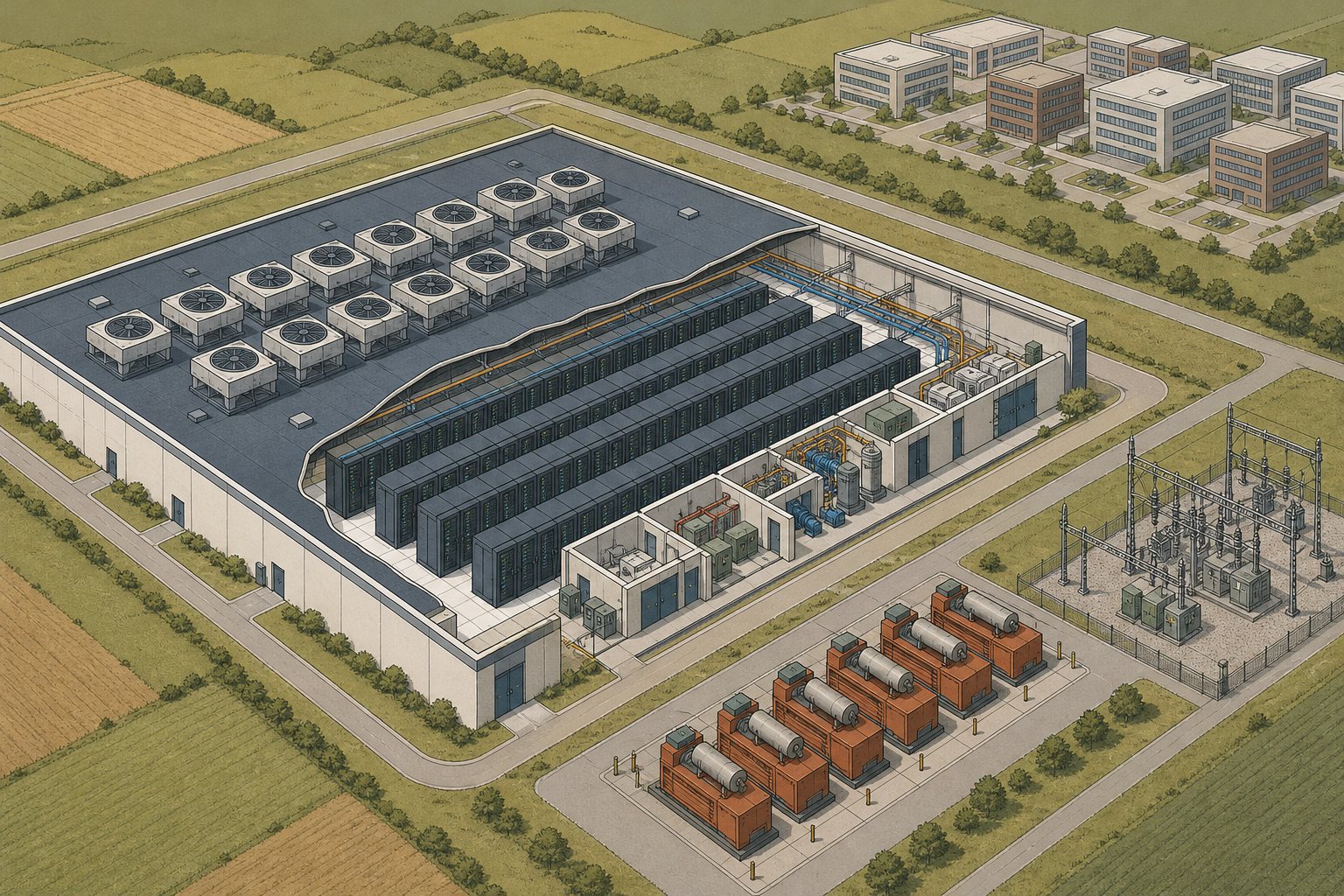
Fly over Loudoun County, Virginia, and the farmland gives way to something strange. Enormous gray boxes sit in rows along the highways, with few windows, if any. Most are one or two stories tall, as if someone had taken an office tower and tipped it over.
This is the busiest data center region on Earth, and it raises an obvious question. Everywhere else, valuable buildings climb. Offices, apartments and hotels stack up as soon as land gets expensive. So why do the buildings that store our photos, stream our shows and answer our chatbot questions sprawl across the ground like parking lots?
The short answer is that what’s inside them is unusually heavy, unusually hot, and, until recently, easy to spread out. The longer answer starts with a metal cabinet.
Part oneA car in a refrigerator-size box
Servers live in racks: steel cabinets about seven feet tall, into which computers slide like trays into a bread cart. Each slot is a “rack unit,” one and three quarter inches high, and a typical rack has forty-two of them.
Words to know
- Rack unit (U)
- One slot in a server rack, 1.75 inches tall. A full rack is usually 42U.
- Data hall
- The big room inside a data center where the racks stand in rows.
- Slab-on-grade
- A concrete floor poured directly on the ground, the cheapest place to put heavy racks.
- Liquid cooling
- Coolant piped to the chips themselves, for racks too hot for air.
- Hyperscale
- The giant data centers run by companies like Amazon, Google, Meta and Microsoft.
For years that arrangement was heavy but manageable. A loaded rack of ordinary servers came in somewhere between 1,500 and 2,500 pounds. Then came hardware built for artificial intelligence, packed with chips, thick metal heat sinks and the plumbing for liquid cooling. An AI server can weigh about 36 pounds for every rack unit it fills, roughly double an ordinary one. Fill a cabinet with it and you get a rack that may need to support around 5,000 pounds, on a patch of floor about the size of a bathtub.
An AI rack outweighs a family car
Typical loaded weight in pounds; bars show the range reported by industry sources
On the ground floor, that weight is easy to live with. The concrete slab rests on the earth, and the earth doesn’t care. Older data halls often raised their racks on false floors of tiles and posts, with cables and cold air running underneath, but strengthening those floors for today’s racks gets expensive. More new buildings simply bolt the racks to the slab.
Upstairs is a different problem. An upper floor is a slab held in the air by beams and columns, and an office floor is designed for desks, chairs and people. Carrying a field of 5,000-pound cabinets takes far more concrete and steel. Then the racks have to get up there. Big operators ask for freight elevators that can lift five metric tons, and elevator makers now sell heavy-duty models aimed squarely at multistory data centers. In earthquake country, strict seismic rules make every extra story cost more again.
A single AI rack can weigh as much as a car. Now picture hundreds of them on the fourth floor.
Part twoNinety space heaters in one cabinet
Weight is the problem you can see. Heat is the one you can’t. Nearly every watt a computer draws ends up as heat in the room, so a data center is, among other things, a very expensive space heater.
A household space heater runs at about 1,500 watts. For most of the internet’s history, a typical rack drew five to ten thousand watts: a handful of space heaters, running around the clock. Nvidia’s GB200 NVL72, one of the best-known AI racks of the past two years, draws roughly 120,000 to 140,000 watts. That’s close to ninety space heaters packed into a single cabinet, and the next generation is designed for more.
How much heat one rack throws off
Power per rack in kilowatts, with the equivalent number of 1,500-watt space heaters
All of that heat has to leave the building, or the chips slow down and fail. For decades the answer was air: cold air in the front of the racks, hot air out the back. But somewhere past thirty to fifty thousand watts per rack, air struggles to keep up, which is why the newest AI racks pipe liquid straight to the chips.
Either way, the heat ends up outdoors, and that’s where the shape of the building starts to matter. In a single-story data hall, hot air can rise straight out through the roof, and the roof itself becomes a work surface for the fans, chillers and cooling towers that dump heat into the sky. Every hall sits under its own patch of roof.
One roof, more floors to cool
Stacking data halls adds heat without adding roof
Stack the halls and the geometry turns against you. Hot air from the lower floors has to be routed up past the floors above, and the building now has three or four times the heat to shed with the same roof it started with. Many data centers also cool themselves by evaporating water, the way sweat cools skin; a mid-sized site can use up to 300,000 gallons a day. Running that water and its pipes up through a tower adds cost and risk.
Part threeThe price of dirt
By the numbers
- 5,000 lb
- What a loaded AI rack may need to support, on a footprint the size of a bathtub
- 88
- Space heaters’ worth of heat from one Nvidia GB200 NVL72 rack
- 2–3
- Stories where building up pays off best, per a Northern Virginia study
- 1/8
- Failure rate of Microsoft’s undersea servers against land, by the company’s own count
If weight pushes data centers down and heat pushes them out, land is the force that eventually pushes back. A data center needs far more ground than its footprint: room for rows of backup generators, an electrical substation, cooling plant, fences and a buffer from the neighbors. A traditional single-story campus was often planned on twenty acres or more. Today’s largest AI campuses are measured in hundreds or thousands.
Where land is cheap, the math is simple. In October 2026, Digital Realty unveiled plans for a campus on 476 acres in Kokomo, Indiana: three buildings, all single-story. But data centers don’t only want cheap land. They want fiber-optic lines, big power connections and nearby users, and in the most popular places that land runs out.
Loudoun County is the case study. Through 2013 it had twenty-one single-story data centers and four with two stories. As parcels grew scarce, developers changed course: of the shared, rented-out data centers built there over the next four years, only three were single-story and eleven had two floors.
Where data centers climb anyway
A few tall examples, and what pushed them up
| Stories | Where | Why it went up |
|---|---|---|
| 32 | Intergate.Manhattan, New York | A former phone company building retrofitted for servers, in one of the costliest places on Earth to buy land |
| 27 | Equinix HK1, Hong Kong | Data halls on several floors of an industrial tower |
| 11 | Meta, Singapore | Built in 2022 on a land-scarce island; the company’s first multistory data center |
| 4 | Google, Iowa and Oklahoma | Google moved to four-story designs as growth sped up in 2015 |
| 4 | CoreSite SV7, Santa Clara | Silicon Valley land prices |
When does climbing pay off? Engineers who ran the numbers for Northern Virginia found that two- and three-story buildings deliver good value for the money, and that the gains shrink after four. Each added floor needs a stiffer frame, bigger elevators and more work to move heat and power. At some point the land you save is eaten by the cost of climbing.
Think of parking. Nobody builds a parking garage in a cornfield, because a flat lot is far cheaper per space. Downtown, a garage is the only way to fit the cars. Data centers are settling into the same pattern: flat where there’s room, taller where there isn’t.
Part fourUnder the sea, under the rock
And then there are the engineers who ran out of options on land altogether.
In 2018, Microsoft sealed 864 servers inside a steel cylinder the size of a shipping container and lowered it 117 feet to the seabed off Scotland’s Orkney Islands. Inside there was no oxygen and no people, only dry nitrogen, with the cold North Sea carrying the heat away. When the team hauled it up two years later, coated in algae, barnacles and sea anemones, Microsoft reported that its servers had failed at about one eighth the rate of identical machines on land. The sample was small: six failures out of the 864 underwater, against eight in a much smaller land group. Microsoft has since said it isn’t building more underwater data centers, but the lessons about sealed, untouched hardware went back to land.
Others went underground. Pionen, in Stockholm, sits about thirty meters inside the bedrock in a former Cold War bunker, behind a steel door, and its builders added gardens, waterfalls and a fish tank to make the place livable for staff. In Helsinki, a data center tucked into an old air raid shelter beneath a cathedral sends its waste heat to warm homes nearby.
So the next time you send a message or ask a chatbot something, picture where it lands. Most likely in a long, low box on cheap land, full of machines too heavy to stack easily and too hot to crowd together. Sometimes in a tower in a crowded city. And once, for two years, at the bottom of the sea.