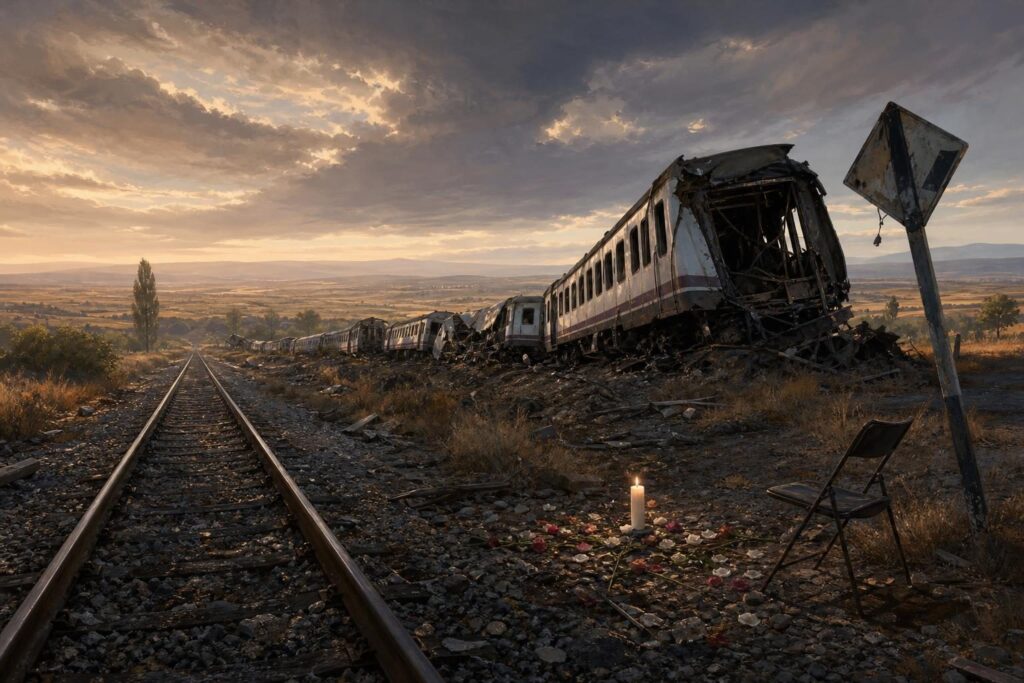
A high-speed train operated by state-owned Renfe collided with a stationary Iryo train near Urda in central Spain on Wednesday, October 28, killing at least 69 people, officials said. The Urda train crash in Spain has revived safety concerns about the country’s rail network.
According to the Straits Times, the Renfe train smashed into the second, stationary train. Prime Minister Pedro Sánchez said 69 people have been confirmed dead and that the toll may rise, according to The Guardian.
The Guardian reports that 110 people were hospitalised. Of those, 71 have been discharged and 39 remain in hospital. Up to 27 nationalities may be among the victims, the newspaper said.
The number of missing people is disputed. According to the Straits Times, the Civil Guard said it had received reports of 64 people missing. The Guardian reports that at least 70 people were reported missing. The outlet sources for these figures differ, and the sources do not explain the gap.
A preliminary report by the accident investigation body AITAT estimated that the Renfe train was travelling between 160 km/h and 200 km/h at the time of the collision, according to the Straits Times. The exact speed is unconfirmed because the black box has not yet been extracted.
Transport Minister Oscar Puente said a controller authorised the Renfe train to proceed at normal speed, disregarding a 40 km/h protocol, according to the Straits Times. This account comes from a single outlet. The sources do not include a response from Renfe or Iryo to the reported authorisation.
The crash comes about 10 months after a collision on the same line at Adamuz, which killed 46 people, according to Al Jazeera. The line’s signalling system is also in question. Al Jazeera quotes an expert who describes the role of the LZB signalling system as partial and disputed. No official finding on the system appears in the sources.
Al Jazeera reports that Spain spent 16 percent of its high-speed rail budget on maintenance from 2018 to 2022, based on European Commission data. Over the same period, Italy, Germany and France spent between 33 and 39 percent, the outlet said.
Spain’s deadliest rail crash remains the 2013 Angrois accident, which killed 80 people, according to Al Jazeera.
Sánchez said confidence in high-speed trains is "broken" and pledged to work on restoring it, according to The Guardian. The government says it will offer solutions to prevent future tragedies, though the sources do not give details.
Identification of the victims is continuing. The Guardian reports that only 13 of the dead have been identified, and 31 body bags containing partial remains await identification. It is unclear how many of the missing are among them. The Guardian’s account is brief and does not give full details of the official briefing.
Next, investigators must extract the black box to confirm the train’s speed. Authorities will also continue identifying the victims, and the final death toll may change as the investigation proceeds.
Sources
This article was written with AI assistance from the published reporting listed above. It is part of the World Brief daily news podcast.